A refrigerated building runs around the clock, carries some of the highest demand charges in commercial real estate, and has the most to lose when the grid goes down. Solar plus storage addresses all three, if it’s designed around the refrigeration load.
Key takeaways
- Refrigeration is roughly two-thirds of a refrigerated warehouse’s electricity and a big driver of demand charges.
- Solar cuts the energy you buy, and storage trims the peaks and can back up critical loads during a power shutoff.
- SDG&E shutoffs can last from several hours to multiple days. Research suggests most refrigerated operations can handle two to four hours of reduced power, but a multi-day shutoff is a different problem.
- Back up what keeps product safe: controls and monitoring, part of the refrigeration capacity, dock equipment, and lighting, IT and security.
- Older warehouse roofs need a structural review first, and commercial solar that begins construction after July 4, 2026 must be in service by December 31, 2027 for the federal credit.
Frequently asked questions
Is solar a good fit for cold storage facilities?
Yes. Warehouses have big, flat, unshaded roofs and steady daytime loads, and refrigeration, roughly two-thirds of a refrigerated warehouse’s electricity, also drives demand charges. Pairing solar with batteries addresses both the energy and the peaks.
How long can a cold storage building go without power?
It depends on the building, the product, the insulation and how often doors open. A 2011 Lawrence Berkeley National Laboratory study found most refrigerated warehouse operations aren’t sensitive to short-term power reductions of two to four hours. A multi-day shutoff needs a backup plan.
What should a battery back up in a warehouse during a power shutoff?
Usually not the whole building. Focus on refrigeration controls and monitoring, enough compressor and evaporator capacity to hold setpoints, dock door and seal equipment, and lighting, IT and security. Solar recharging during the day extends how long the battery can carry those loads.
Can my warehouse roof support solar panels?
It needs an engineer’s review first. Older tilt-up and light-framed roofs weren’t always built with extra load capacity. If the roof is near the end of its life, replacing it before the solar goes on is usually the better order, and parking canopies or ground mounts can work where the roof can’t.
Do new warehouses in California have to include solar?
Many do. California’s 2025 Building Energy Efficiency Standards, which apply to permit applications filed on or after January 1, 2026, require solar and, in most cases, battery storage on many newly constructed nonresidential buildings, including conditioned warehouses in many climate zones. Unconditioned warehouses are exempt.
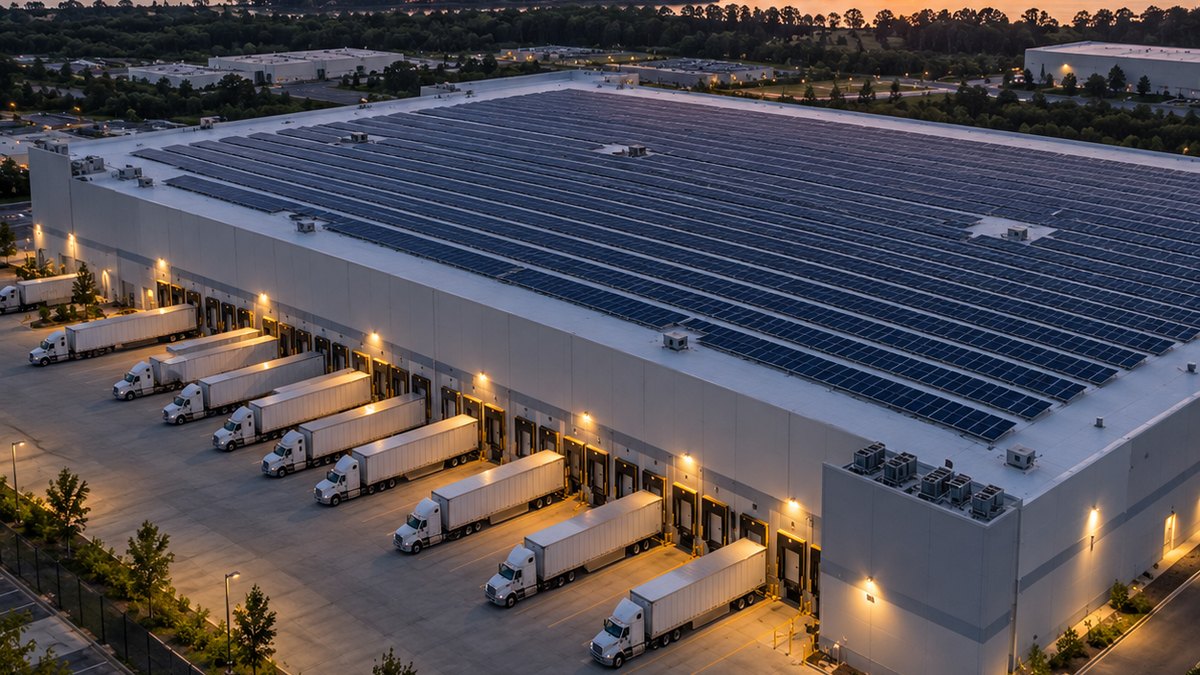
Warehouses and cold storage buildings are close to ideal for solar. They have big, flat, unshaded roofs, steady daytime loads and predictable operations, and solar for cold storage facilities deserves its own playbook. Cold storage adds two pressures most buildings don’t have: refrigeration that can’t stop, and inventory that spoils when it does.
In Southern California, that second pressure has a name. Public Safety Power Shutoffs can take a building offline for days during fire weather, usually with advance notice but no guarantee of when power comes back.
Refrigeration drives the bill
In refrigerated warehouses, refrigeration is the dominant load. California Energy Commission survey data put it at roughly two-thirds of a refrigerated warehouse’s electricity use. That load also shapes demand charges: compressors cycling up together on a hot afternoon can set a monthly peak that drives a large share of the bill.
That’s why cold storage solar projects usually pair panels with batteries. Solar reduces the energy you buy, and storage trims the peaks. We explain the demand-charge side in our post on commercial batteries and demand charges.
What a power shutoff means for a cold storage building
SDG&E can de-energize lines in high fire-risk areas when fire weather builds, typically during Santa Ana wind season. The utility says shutoffs can last from several hours to multiple days, because crews must inspect lines in daylight before restoring power. In January 2025, one SDG&E shutoff event ran from January 7 to January 16 and affected more than 15,000 customers at various points. SDG&E posts active events on its PSPS dashboard.
How long product holds without power depends on the building, the product, the insulation and how often doors open. A 2011 Lawrence Berkeley National Laboratory study of refrigerated warehouses found that most operations aren’t sensitive to short-term power reductions of two to four hours. A multi-day shutoff is a different problem.
Backing up what matters
Backing up an entire cold storage building is rarely practical or necessary. The design question is which loads keep product safe and the business running:
- Refrigeration controls and monitoring, so you know what temperatures are doing
- A share of compressor and evaporator capacity, enough to hold setpoints rather than pull down a warm room
- Dock door and seal equipment, so the cold stays in
- Lighting, IT and security for the people still working
A battery system sized to those critical loads, with solar recharging it during the day, can carry a building through a much longer outage than a battery alone. Some operations also add load management so compressors start in sequence instead of all at once.
Roofs need a structural look
Warehouse roofs are big, but older tilt-up and light-framed roofs weren’t always built with extra load capacity. Before designing a rooftop array, an engineer should review the structure, the roof’s age and its remaining life. If the roof is near the end of its life, replacing it before the solar goes on is usually the better order of operations. Where the roof can’t carry it, parking canopies or ground mounts can.
New buildings now have to include solar and storage
California’s 2025 Building Energy Efficiency Standards apply to permit applications filed on or after January 1, 2026, and they require solar and, in most cases, battery storage on many newly constructed nonresidential buildings, including conditioned warehouses in many climate zones, with exceptions for small systems and limited roof area. Unconditioned warehouses are exempt. If you’re planning a new building, ask your designer how the 2025 Energy Code applies to your building type. For existing buildings, solar and storage are a choice, and the federal clock makes the timing matter.
The federal deadline
Under IRS Notice 2025-42, commercial solar projects that begin construction after July 4, 2026 must be placed in service by December 31, 2027 to claim the federal investment tax credit. Battery storage has a longer runway under current law. New federal rules also restrict equipment sourced from certain foreign entities for projects that begin construction after 2025, so confirm your supply chain qualifies. For a warehouse starting now, that means the solar half of the project needs a schedule that lands by the end of 2027.
Buildings we’ve powered
Stellar Solar has installed solar on refrigerated and distribution buildings including Lomo Cold Storage and the Shaw Distribution Center.
Keep your product cold and your bill down
If you run a warehouse or cold storage building, Stellar Solar can model solar and storage around your refrigeration load, your demand charges and your exposure to power shutoffs. Stellar Solar has engineered and installed commercial solar, carports and storage across Southern California since 1998, A+ rated with the BBB and a repeat winner of San Diego’s Best Solar in the Union-Tribune Readers Poll. Call 866.787.6527 for a free commercial evaluation, or visit stellarsolarcommercial.com.
Sources & further reading
Shutoffs & refrigeration
- SDG&E PSPS dashboard
- How SDG&E decides on a Public Safety Power Shutoff
- Lawrence Berkeley National Laboratory: demand response opportunities in refrigerated warehouses
Codes, tax & incentives
- California Energy Commission: 2025 Energy Code support center
- IRS Notice 2025-42: beginning of construction
- 26 U.S. Code Section 48E
Stellar Solar credibility