
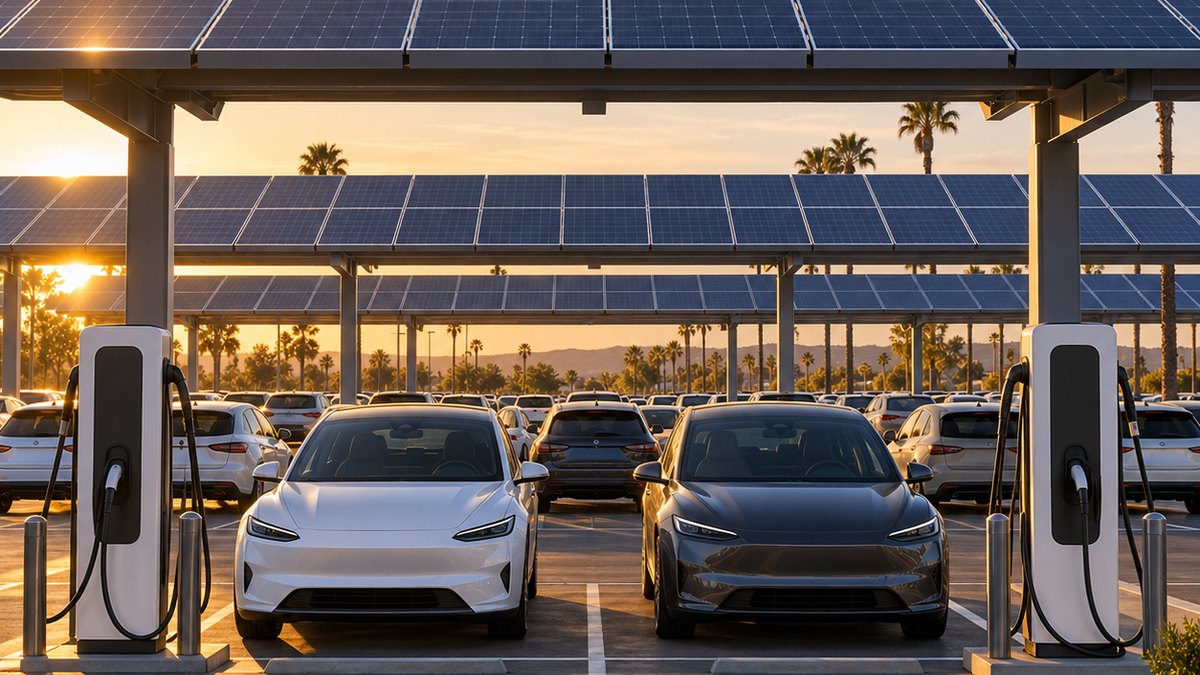
A dealership has three things solar loves: big flat roofs, acres of paved lot, and business hours that line up with the sun. Add EV chargers to the mix and it has one more: demand charges that a battery can cut down to size.
Key takeaways
- Dealerships suit solar: big flat roofs, large paved lots for solar canopies, and business hours that line up with the sun.
- EV chargers add demand charges. On SDG&E’s AL-TOU rate, one 150 kW fast charger that sets both summer peaks could add roughly $17,000 in a month.
- Battery storage, an EV-specific rate and charger management can tame charger demand, with solar cutting the energy portion of the bill underneath.
- The federal Section 48E credit can be 30 percent, but solar projects that begin construction after July 4, 2026 must be placed in service by December 31, 2027.
- Payback depends on your rate schedule, on-site use, batteries, the rooftop and canopy mix, and your tax position.
Frequently asked questions
Why are car dealerships going solar?
A dealership has large flat roofs, acres of paved lot for solar canopies, and business hours that line up with solar production. EV chargers have added demand charges, and solar plus storage can cut both the energy and the demand side of the bill.
How do EV chargers affect a dealership’s electric bill?
Commercial rates bill for your highest 15-minute power draw in the month. On SDG&E’s AL-TOU rate (secondary voltage, as of June 1, 2026), that’s $44.45 per kW plus $69.09 per kW for the peak during summer on-peak hours, so one 150 kW fast charger at the wrong time could add roughly $17,000 in a single month.
Can a battery reduce dealership demand charges?
Yes. A commercial battery can cover the spike when a fast charger kicks on, so the utility meter never sees the full peak. Most dealerships combine storage with an EV-specific rate or charger scheduling.
What is the commercial solar tax credit in 2026?
The federal investment tax credit under Section 48E is 30 percent for projects that meet prevailing wage and apprenticeship requirements or are under 1 MW AC, with possible 10-point adders for domestic content and energy communities. Under IRS Notice 2025-42, solar projects that begin construction after July 4, 2026 must be placed in service by December 31, 2027 to claim it.
Are solar canopies worth it for a car lot?
Canopies cost more per watt than rooftop solar because of the steel and foundations, but they produce well and shade cars and customers. The mix of rooftop and canopy is one of the main drivers of a dealership’s payback.
Car dealerships across California are going solar, and it’s not a branding exercise. A typical store runs lights, HVAC, compressors, lifts and computers from early morning into the evening, six or seven days a week. It sits on a large roof and a larger parking lot. And more and more stores now have EV chargers that can spike the electric bill in ways the old building never did.
Here’s how the pieces fit, and what drives payback.
The roof, the lot and the canopy
Most dealerships have two places to put solar:
- The roofs. Showroom and shop buildings usually have large, flat roofs that can carry a substantial array without touching the lot.
- The lot. Solar canopies over customer parking, employee parking or inventory rows turn a car lot’s paved space into generating space. They also shade cars and customers from the Southern California sun.
Canopies cost more per watt than rooftop solar because of the steel and foundations, but they produce well and protect what’s parked under them. We break down that tradeoff in what a commercial solar carport costs compared with a rooftop.
EV chargers changed the dealership electric bill
Automakers have pushed dealers toward EV readiness for years, with requirements that have shifted over time. Cadillac asked dealers in 2020 to invest at least $200,000 in charging, training and tools to sell EVs. Ford’s Model e program initially required DC fast chargers before Ford removed the fast-charger requirement in late 2023 and scrapped the program in 2024; Ford’s 2024 rules require two Level 2 chargers. Whatever your franchise requires today, many stores now have chargers on site, and fast chargers draw a lot of power in a short time.
That’s where demand charges come in. Commercial rates bill not only for energy used but for your highest 15-minute power draw in the month. On SDG&E’s AL-TOU rate (secondary voltage) as of June 1, 2026, that means a non-coincident demand charge of $44.45 per kW, plus $69.09 per kW for the peak during summer on-peak hours, according to SDG&E’s large commercial rate summary.
Run the arithmetic on one 150 kW fast charger that sets both peaks in a summer month: 150 kW times $113.54 is roughly $17,000 in demand charges from a single session at the wrong time.
Three ways to tame charger demand
- Battery storage. A commercial battery can cover the spike when a fast charger kicks on, so the utility meter never sees the full peak. We explain how that works in our post on commercial batteries and demand charges.
- An EV-specific rate. SDG&E’s EV-HP rate for separately metered chargers over 20 kW replaces traditional demand charges with a monthly subscription in set kilowatt steps. SCE’s TOU-EV-8 and TOU-EV-9 rates currently carry no demand charges, according to SCE’s EV rate fact sheet, though they require a dedicated meter.
- Charger management. Scheduling and power limits keep several chargers from peaking at once.
Most dealerships use a combination, and solar reduces the energy portion of the bill underneath all of it.
The federal credit has a clock on it
The biggest solar incentive for auto dealerships is the federal investment tax credit for commercial solar under Section 48E. It’s still available, but it has a firm end date. Under IRS Notice 2025-42, solar projects that begin construction after July 4, 2026 must be placed in service by December 31, 2027 to claim the credit. For a dealership starting a project now, that means design, permits, interconnection and installation all have to fit in less than 15 months.
The credit is 30 percent for projects that meet prevailing wage and apprenticeship requirements, or that are under 1 MW AC, with possible 10-point adders for domestic content and energy communities. Battery storage has a longer runway than solar under current law. New federal rules also restrict equipment sourced from certain foreign entities for projects that begin construction after 2025, so confirm your supply chain qualifies. Depreciation rules for solar also changed in 2025, so ask your CPA how your project will be treated before you budget around it.
What drives payback
Every store is different, but payback comes down to a handful of factors:
- Your current rate schedule and demand charges
- How much of the solar is used on site during business hours
- Whether batteries are added to manage charger and HVAC peaks
- The mix of rooftop and canopy
- The federal credit and your tax position
We walk through the numbers in more detail in our guide to commercial solar cost and payback in Southern California.
Dealerships we’ve powered
Stellar Solar has installed solar for dealerships including Herman Cook Volkswagen, Capistrano Volkswagen and Capistrano Mazda, and for auto businesses like Encinitas Foreign & Domestic Auto.
Get your store’s numbers
If you’re adding chargers, renewing your lot, or just tired of watching the demand line on your bill, Stellar Solar can model rooftop, canopy and battery options against your actual rate schedule, and map out a timeline that fits the federal deadline. Stellar Solar has engineered and installed commercial solar, carports and storage across Southern California since 1998, A+ rated with the BBB and a repeat winner of San Diego’s Best Solar in the Union-Tribune Readers Poll. Call 866.787.6527 for a free commercial evaluation, or visit stellarsolarcommercial.com.
Sources & further reading
Rates & demand charges
- SDG&E large commercial rate summary (June 1, 2026)
- SDG&E EV-HP rate fact sheet
- SCE TOU-EV-7, 8 and 9 rate fact sheet
Federal tax & financing
Stellar Solar credibility